INVESTING IN TRANSPORT IN THE NEW MFF: A NEW STUDY REVEALS HOW EU FUNDING CAN DELIVER BETTER VALUE IN 2028–2034
On 5 May 2026, Dr José F. Papí, CEO of Etelätär Innovation, and STA President, presented to the European Parliament’s Committee on Transport and Tourism (TRAN) a new study titled “Investing in Transport in the new MFF”, an evidence-based assessment of how EU transport investments can deliver stronger value for money in the 2028–2034 Multiannual Financial Framework (MFF), aimed at informing upcoming parliamentary discussions and negotiations.
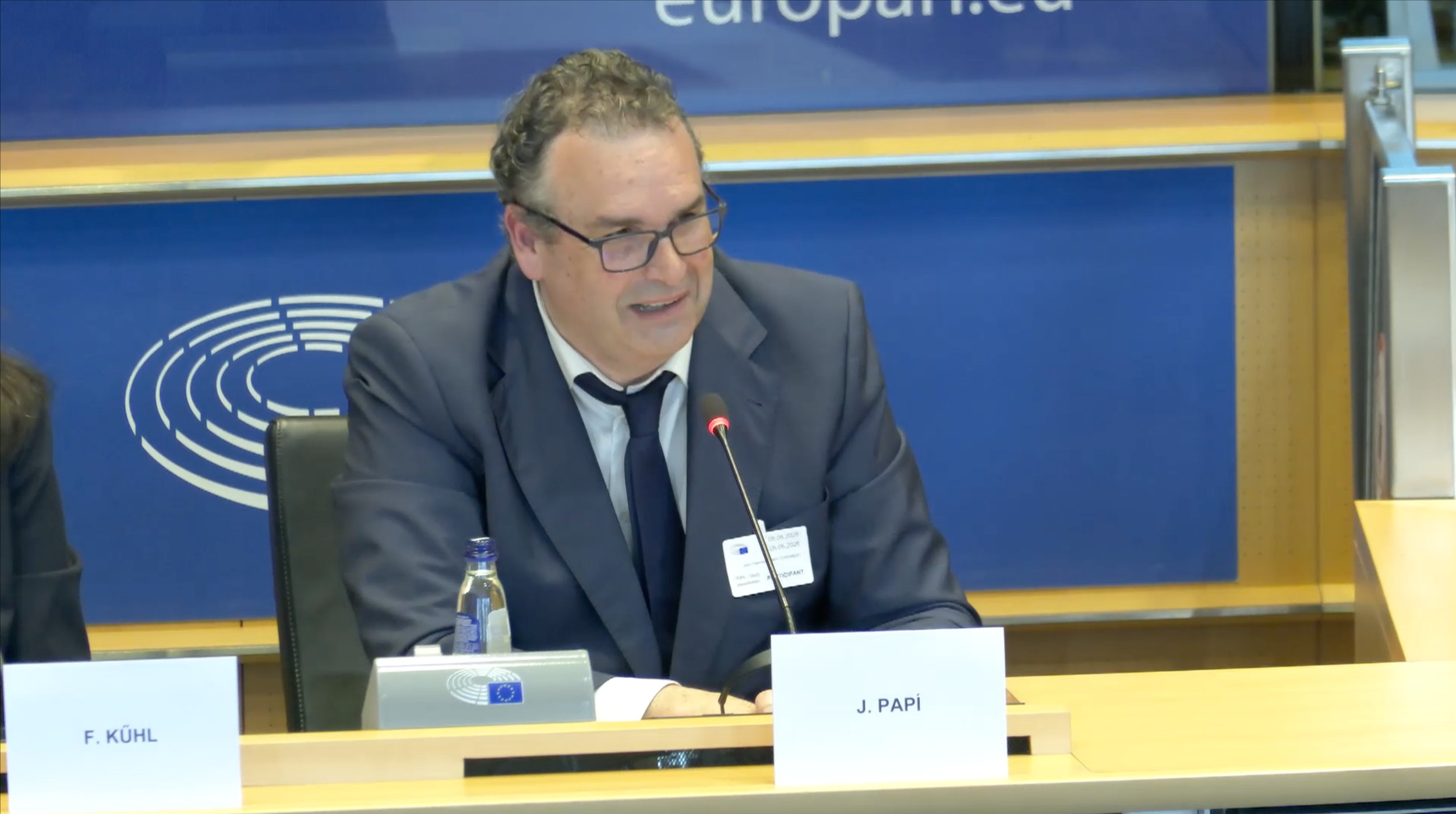
Dr José F. Papí presenting the ‘Investing in Transport in the new MFF’ survey at the Committee on Transport and Tourism (TRAN) meeting, 5 May 2026.
The study analyses how key EU funding instruments, including the Connecting Europe Facility - Transport (CEF-Transport), cohesion policy funds, the proposed European Competitiveness Fund, InvestEU, and the European Investment Bank interact within a complex financial system. It also examines how flexibility and performance frameworks can support completion of the Trans-European Transport Network (TEN-T), alongside decarbonisation, security, and cohesion objectives.
Transport investments under the current 2021–2027 MFF sit at the intersection of cohesion, climate, and competitiveness policies, relying on a mix of grants, loans, guarantees, and recovery instruments. This architecture already anticipates many elements proposed for 2028–2034, making it a key reference point for assessing value for money and drawing lessons for the next cycle.
Structured in seven sections, the report outlines how EU transport investment is organised today. Grants from CEF-Transport, the Cohesion Fund, and the European Regional Development Fund are combined with loans and guarantees from the European Investment Bank and InvestEU, complemented by temporary recovery tools such as NextGenerationEU and the Recovery and Resilience Facility. Together, these instruments finance infrastructure across TEN-T and urban and regional networks, with a clear division of labour between strategic, cohesion, and market-based interventions.
However, implementation has been uneven across Member States and corridors, reflecting differences in administrative capacity, project pipelines, and national co-financing. In some cases, fragmented governance and limited coordination have contributed to delays or under-absorption, while stronger project preparation has enabled more effective use of EU support.
Looking ahead to the proposed 2028–2034 framework, the package could include a reinforced CEF-Transport, transport windows under a European Competitiveness Fund, redesigned cohesion instruments under National and Regional Partnership Plans, a successor to Horizon Europe, and continued InvestEU and European Investment Bank financing. The study finds this configuration can generate higher European added value if roles are clearer and coordination is strengthened, particularly by focusing CEF-Transport on cross-border and dual-use projects unlikely to proceed without EU support.
Key Challenges
Oversubscribed funding and uneven capacity: high demand for CEF-Transport and disparities in regional administrative capacity limit effective absorption
Delays and cost overruns: major infrastructure projects face persistent implementation risks, affecting delivery and impact
Weak outcome-based monitoring: limited performance tracking reduces the ability to assess value for money
The study recommends concentrating resources on high-impact projects, strengthening conditionalities and technical support, improving coordination between research and deployment, and reinforcing performance indicators and governance.
Key Recommendations
Strengthen CEF-Transport as the EU backbone: prioritise cross-border TEN-T, dual-use infrastructure, and strategic corridors with a stable funding envelope
Improve coordination and cohesion: better align EU instruments and safeguard cohesion funding for sustainable, high-impact transport projects
Enhance performance and financing tools: introduce outcome-based indicators and scale up simplified blended finance via InvestEU and the European Investment Bank
The study concludes that the effectiveness of EU transport investment will depend not only on funding levels, but on how well instruments are coordinated and aligned with strategic priorities.