
STA EPT 2/2026 FINDINGS: EXPERTS URGE GREATER INVESTMENT IN PHYSICAL INFRASTRUCTURE WHILE TRUST IN AI REMAINS LIMITED
Transport experts are calling for stronger investment in physical infrastructure and greater confidence in financing mechanisms as Europe faces growing pressure to modernise ageing networks, accelerate decarbonisation, and strengthen resilience and military preparedness, according to the 2/2026 edition of the STA Expert Perception Tracker.
The survey was conducted from 15 to 29 May 2026 and gathered 106 responses from transport experts across 21 countries, offering insight into how experts believe Europe should finance and prioritise the transport systems needed for future economic growth.
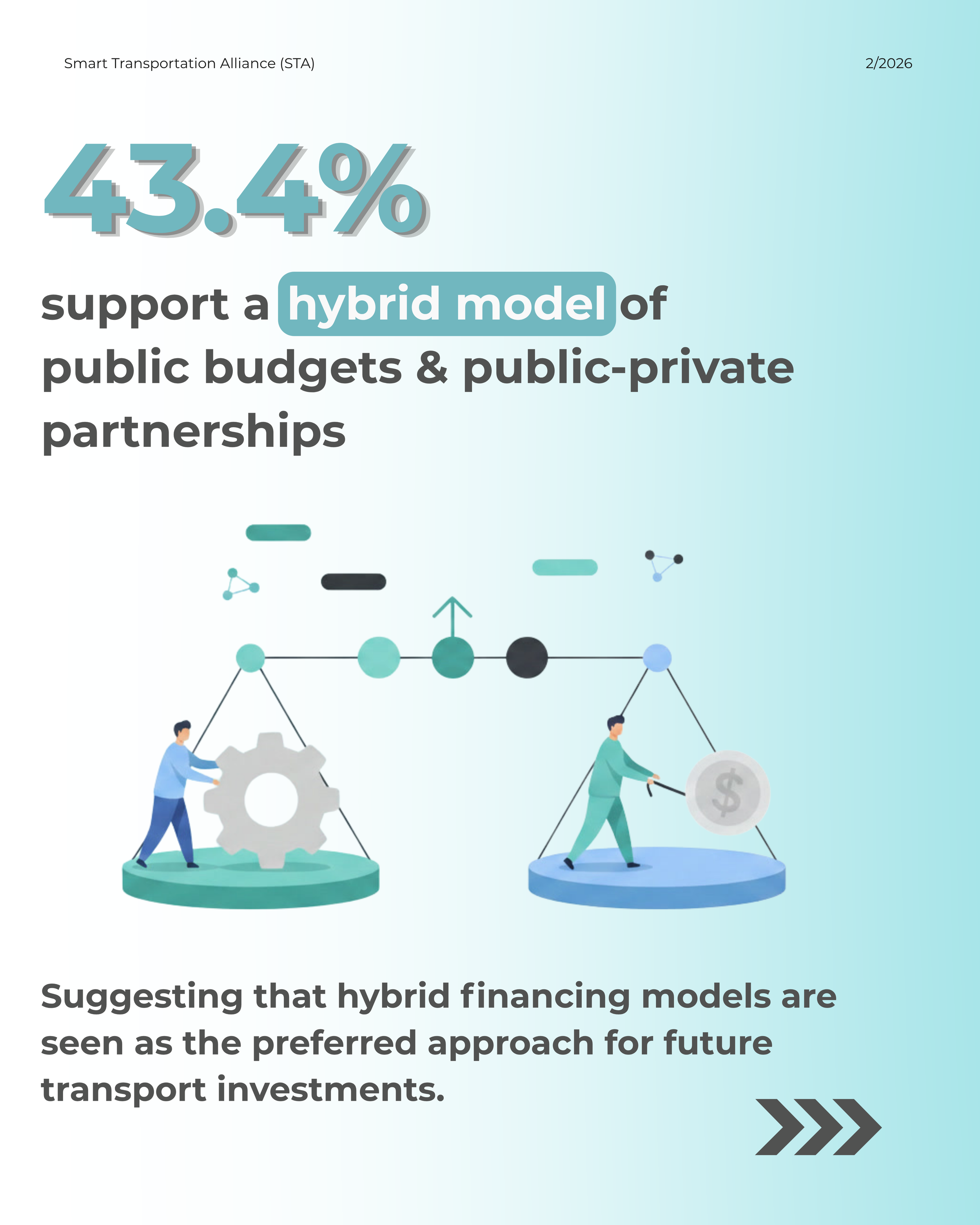
The findings suggest a clear preference for hybrid financing approaches. More than 43% of respondents consider a combination of public funding and public-private partnerships to be the most effective model for transport infrastructure investment, while a further 30% favour predominantly public financing complemented by limited private participation. Only a small minority support largely private financing models.
According to Thierry Vaneslander, Professor at the University of Antwerp and Member of the STA Management Committee, “the results clearly highlight that decision-makers are well-aware about public budget constraints as well as the potential that public-private funding has for project efficiency and effectiveness.”
Furthermore, the findings demonstrate growing awareness among decision-makers of both public budget limitations and the potential benefits that public-private funding models can bring in terms of project efficiency and delivery. Despite growing investment in digitalisation and electrification, experts argue that physical infrastructure remains the foundation of Europe’s transport modernisation. Nearly nine out of ten respondents believe stronger investment in physical transport infrastructure is necessary as transport systems become increasingly interconnected and dependent on resilient networks. Almost half of the respondents strongly agree that investment in physical infrastructure should become a priority, while an additional 40% agree.
José Manuel Vassallo, Professor at the Technical University of Madrid, Director of the Transport Research Center(TRANSyT), and Chair of STA Technical Committee on Financing, adds: “The findings are not surprising, as digitalisation and climate resilience do require substantial investment, but these transitions ultimately rely on strong physical infrastructure.”
The survey also sends a clear message about the role of Artificial Intelligence (AI) in the decision-making process: while most experts recognise the benefits of AI-supported investment tools and digital decision-support systems, trust remains limited. AI-driven decision-support systems are generally perceived as useful supporting mechanisms rather than decisive tools for investment decisions, while around 9% of respondents consider current systems insufficiently reliable for critical investment choices.
Overall, the findings point towards a future in which transport infrastructure planning increasingly combines public-private collaboration, investment in the physical layer, and carefully integrated digital tools to meet Europe’s long-term transport ambitions.
Read the full press release& key findings.